Wi-Fi 6 is short for the next-generation 802.11ax standard. With the evolution of the Wi-Fi standard, WFA chose to rename Wi-Fi with a numeric serial number in order to facilitate Wi-Fi users and device manufacturers to easily understand the Wi-Fi models that their devices are connected to or supported. On the other hand, the next-generation naming method is also chosen to better highlight the major advances in Wi-Fi technology. It provides a large number of new features, including increased throughput and faster speeds, and support for more concurrent connections. According to the WFA announcement, the current Wi-Fi names correspond to the following 802.11 technical standards:
Year published
802.11 Standards
Frequency bands
Renaming
2009
802.11n
2.4 GHz or 5 GHz
Wi-Fi 4
2013
802.11ac wave1
5 GHz
Wi-Fi 5
2015
802.11ac wave2
5 GHz
2019
802.11ax
2.4 GHz or 5 GHz
Wi-Fi 6
Table 1 802.11 standards and new names
Like every 802.11 standard released in the past, 802.11ax will also be compatible with the previous 802.11ac/n/g/a/b standard. Old terminals can also seamlessly access the 802.11ax network.
How fast is Wi-Fi 6? 4G is synonymous with high speed of mobile networks. Similarly, Wi-Fi 6 is Synonym of high speed of wireless LAN. How high speed comes from is determined by the following factors. Calculation formula:
Machine rate = number of spatial streams*1/(Symbol+GI)*coding method*code rate*number of effective sub-carriers (1) The number of spatial streams
The spatial flow is actually the antenna of the AP. The more the number of antennas, the greater the throughput of the whole machine. Just like the lanes of a highway, 8-lane will definitely carry more traffic than four lanes.
802.11a/g
802.11n
802.11ac
802.11ax
Single radio
Maximum spatial flow
1
4
8
8
Table 2 The number of spatial streams corresponding to different 802.11 standards
(2)Symbol and GI
Symbol is the transmission signal in the time domain, and a certain gap (GI) between adjacent symbols is required to avoid interference between symbols. Just like China's high-speed rail, each train is equivalent to a symbol, and there must be a time gap between two trains from the same station, otherwise the two trains may collide. The gaps under different Wi-Fi standards are also different. Generally speaking, when the transmission speed is faster, the GI needs to be increased appropriately, just like the departure time gap between two 350KM/h high-speed trains on the same lane is larger than the 250KM/h high-speed train.
Before 802.11ac
802.11ax
Symbol
3.2 us
12.8 us
Short GI
0.4 us
/
GI
0.8 us
0.8 us
2*GI
/
1.6 us
4*GI
/
3.2 us
Table 3 Symbol and GI data corresponding to 802.11 standard
(3) Coding method
The coding method is the modulation technology, that is, the number of bits that can be carried in a symbol. From Wi-Fi 1 to Wi-Fi 6, every time the modulation technology is improved, the rate of each spatial stream can be increased by at least 20%.
802.11a/g
802.11n
802.11ac
802.11ax
Highest order modulation
64 QAM
64 QAM
256 QAM
1024 QAM
Number of bit /Symbol
6
6
8
10
Table 4 QAM corresponding to 802.11 standard
(4) Bit rate
Theoretically, it should be transmitted losslessly according to the encoding method, but the reality is not so rosy. Some information codes for error correction need to be added during transmission, and redundancy is exchanged for high reliability. The code rate is the ratio of the actual data code to the theoretical value after the error correction code is excluded.
Scheme
Modulation
802.11a/g
802.11n
802.11ac
802.11ax
MCS0
BPSK
1/2
1/2
1/2
1/2
MCS1
QPSK
1/2
1/2
1/2
1/2
MCS2
QPSK
3/4
3/4
3/4
3/4
MCS3
16-QAM
1/2
1/2
1/2
1/2
MCS4
16-QAM
3/4
3/4
3/4
3/4
MCS5
64-QAM
2/3
2/3
2/3
2/3
MCS6
64-QAM
3/4
3/4
3/4
3/4
MCS7
64-QAM
5/6
5/6
5/6
5/6
VMCS8
256-QAM
-
-
3/4
3/4
VMCS9
256-QAM
-
-
5/6
5/6
VMCS10
1024-QAM
-
-
-
3/4
VMC11
1024-QAM
-
-
-
5/6
Table 5 Code rate corresponding to 802.11 standard
(5) Number of effective sub-carriers
The carrier is similar to the symbol in the frequency domain. One sub-carrier carries one symbol, and the number of sub-carriers under different modulation methods and bandwidths is various.
Bandwidth
802.11n
802.11ac
802.11ax
Minimum Carrier Bandwidth
-
312.5 KHz
312.5 KHz
78.125KHz
Number of valid sub-carriers
HT20
52
52
234
HT40
108
108
468
HT80
-
234
980
HT160
-
2 x 234
2 x 980
Table 6 Number of sub-carriers corresponding to 802.11 standard
At this point, we can calculate the maximum rate of a single spatial stream of 802.11ac and 802.11ax under the HT80 bandwidth:
PHY
1/(Symbol+GI)
Number of bit /Symbol
Code rate
Effective subcarrier
Rate
802.11ac
1/(3.2us+0.4us)
8
5/6
234
433 Mbit/s
802.11ax
1/(12.8us+0.8us)
10
5/6
980
600 Mbit/s
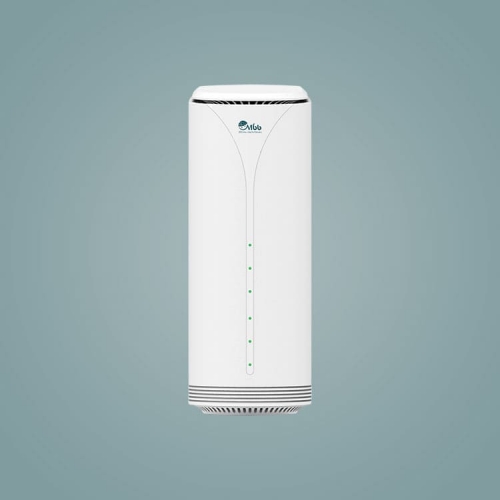
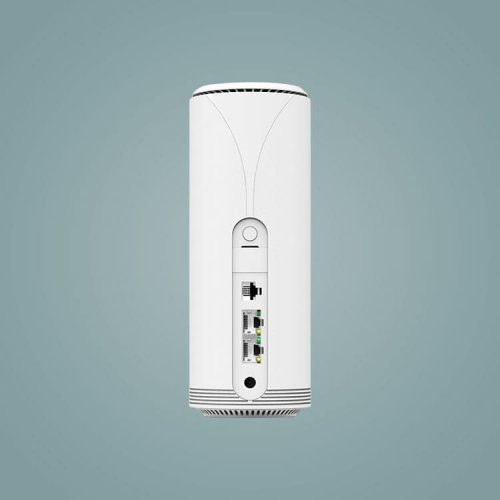
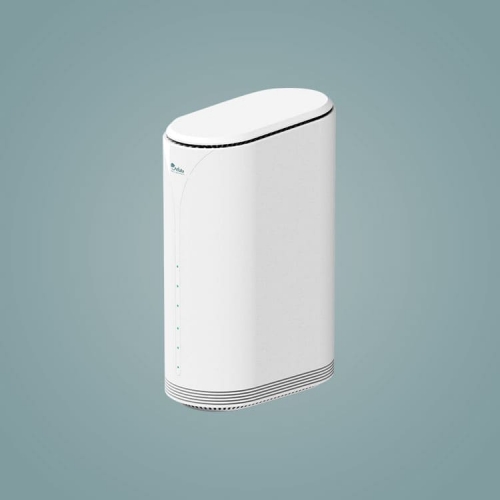
SmileMbb, a subsidiary of V-SOL, has rapidly launched 5G CPE Router XZC5552 product supporting wi-fi6,the device adopts qualcomm QCA6391 Wifi chipset,this chipset supports Wi-fi6 Technology, According to the above calculation method, in 2.4Ghz, we can calculate the maximum rate of two spatial streams of 802.11ax under HT40 bandwidth is 573.5Mbit/s. in 5Ghz, we can calculate the maximum rate of two spatial streams of 802.11ax under HT80 bandwidth is 1201Mbit/s.
5G Indoor CPE
Item No.: XZC5552
The WiFi 5G router XZC5552 is a highly advanced device, with Qualcomm SDX55 chipset, providing hyper 5G experience for global carriers and partners. Adopt simple, integrated and fashionable design with all-new 5G smart antenna.Enjoy the Gigabit era.
Chip platform
Qualcomm SDX55
Size
190*124*70mm
Weight
600g
802.11a/b/g/n/ac/ax
2.4GHz 2*2MIMO 802.11ax :575Mbps
5GHz 2*2MIMO 802.11ax : 1.2Gbps
DBS can up to 1.775Gbps
1*1Gibabit WAN/LAN RJ45 Port
1*1Gibabit LAN RJ45 Port
1*RJ11 Port
1*1.8V & 3V 4FF (U)SIM
1*DC Input Port